
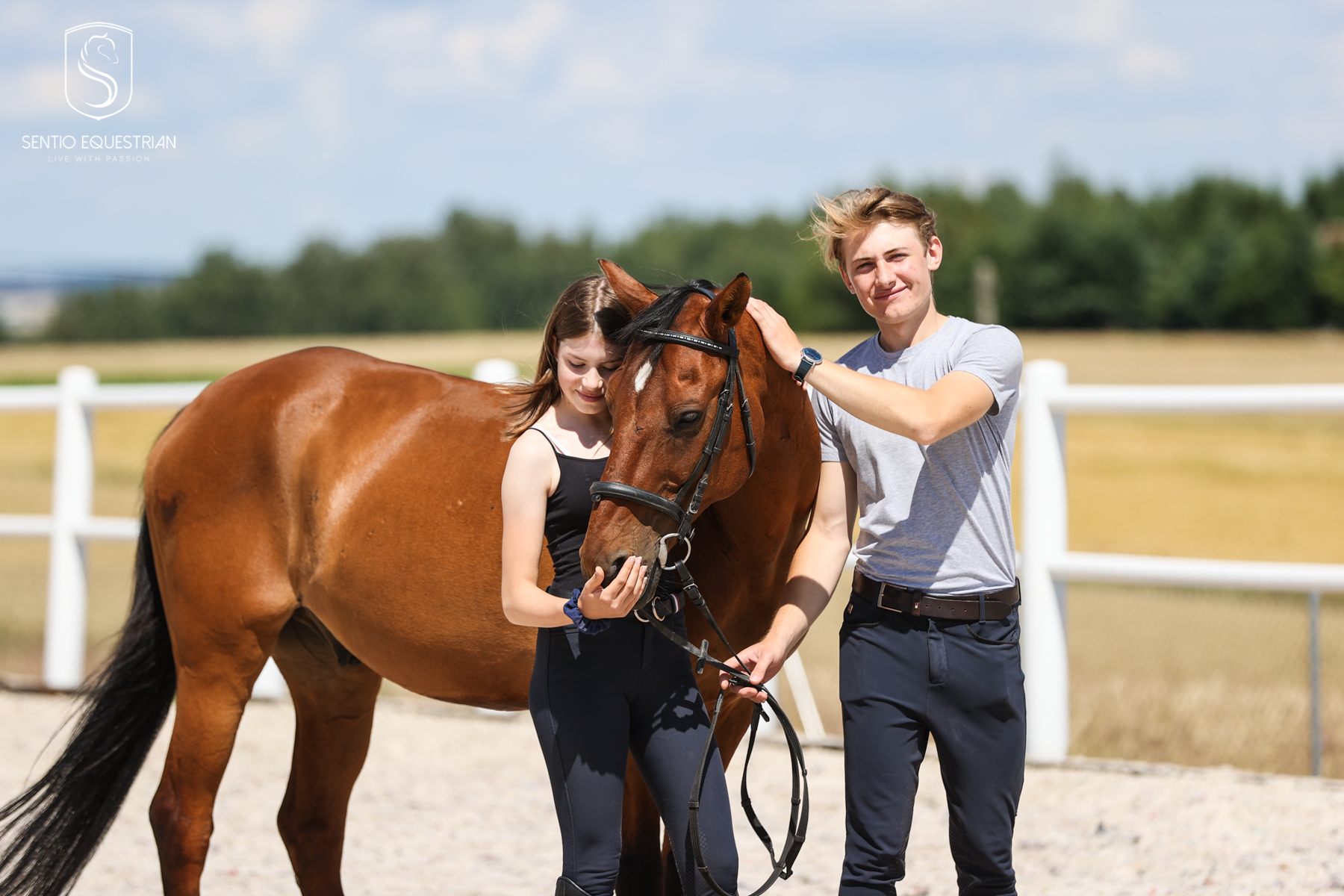
Horse Riding vs. Other Sports — What No Other Training Gives
What really happens to a person learning to look after a horse
"Horse riding is the only sport in which the outcome depends on the trust of a living being — not on equipment, not on strength, but on the relationship."
That single thought explains everything. It explains why children who come to the stables regularly go home different from how they arrived. Calmer, more attentive, more responsible. Not because a coach told them to. Because the horse taught them — quietly, without words, simply by being there.
No other sport gives that in the same way.
No partner reacts as honestly
In football, you can pretend to listen to the coach. At the pool, you can swim a little slower and no one notices. In tennis, you can convince yourself it's the court, not your forehand, that lacks precision.
A horse doesn't buy that.
A horse reads your breath. The tension in your muscles, the pace at which you approach its stall. A rider who walks into the stable with their head full of stress from school will feel it immediately — not as punishment, but as feedback no human coach could give with the same precision. The animal doesn't judge. It only responds.
And that is exactly why it is the most honest training partner you could have.
A responsibility you can't put off till tomorrow
In most sports you can have a bad day and no one really suffers. You can show up without enthusiasm, go through the motions, head home.
Horse riding is different.
The horse is waiting for you whether you feel like it or not. It has to be groomed, you have to connect with it, greet it before you mount, prepare the tack. In summer, in winter, in the middle of exam week and on the week when everything else is going wrong. That regularity — repeated, unavoidable, charged with real care for someone other than yourself — builds something in a child that no other sport offers on the same scale: the feeling that someone is counting on me.
Not the coach, not the parents. The horse.
It's hard not to take that seriously.
A relationship that takes patience
Other sports reward speed, strength, reflex.
Horse riding rewards patience.
You can't rush a relationship with a horse. You can only build it — gradually, through repeated hours at the stall, in the saddle, in the paddock. Children who understand this learn something you won't find in any school textbook: that real trust is not the reward for one good gesture. That it is built slowly, out of consistency and calm. That it is worth waiting for.
What we really train in our lessons
We talk about technique, about position, about pole work. But alongside it, something happens that doesn't show up in competition videos.
An eight-year-old who, for the first time, has prepared her horse on her own — checked the bridle, placed the saddle, checked the girth — looks at herself differently than she did an hour earlier. Not because someone told her she's great. Because the horse trusted her. It stood quietly — because she earned that quietness.
That is a moment you can't plan or buy. It simply happens — in the stable, quietly, without fanfare.
That's why horse riding is different
In any sport, you can come to love competition.
In horse riding, you learn something else too: how to care for someone weaker than you. How to recognise that today isn't their day. How to adapt to a partner, instead of imposing your own pace.
These are skills that walk out of the stable and into life.
So the question isn't: is it worth signing your child up for riding lessons?
The question is: what else are you waiting for?
Want to see if horse riding is right for your child?
A first trial lesson at Sentio Equestrian lets you decide together — safely, calmly, with no commitment. Find the details in our Academy section.
Go to Academy →Sentio Equestrian · Sports Club Association